
How Does the NovusAer Whole-Home Air Filter Compare to Bipolar Ionization Systems?

By Dan Dearden, CAFS, Founder, Essential Air Products
Homeowners today have more choices than ever when it comes to improving indoor air quality. Two popular categories are:
1. Advanced whole-home air filters (like the NovusAer)
2. Bipolar ionization devices (such as the iWave by NuShield, Purifi by PurifiLabs, or the DM-2 by GPS)
Both claim to “purify” the air—but they do it in very different ways. And those differences matter.
Below is a homeowner-friendly breakdown to help you understand how each method works, where each shines, and what you should consider before choosing an air-purifying solution.
Filtration vs. Ionization: What’s the Difference?
NovusAer – Purifies the air through filtration
The NovusAer system uses physical filtration—capturing harmful airborne particles and removing them from your home’s air.
If you want to understand the difference between purification, filtration, and ventilation, check out my article on that topic.

Bipolar Ionizers – Purify with electrically charged ions
Devices like the iWave, Purifi, and GPS DM-2 release positive and negative ions into your air. These ions:
Break down certain VOC chemicals in the air
Interact with viruses, bacteria, and mold
Help increase the efficiency of air filters through the process of agglomeration. The positive and negative ions attach to the nanoparticles in the air that are 1 micron and smaller (≤ PM 1.0). These positively and negatively charged particles now attach to each other, or agglomerate, to create a larger group of particles that are more easily caught in an air filter.
Agglomeration can increase filtration performance by about 5–8%.
A Key Issue: Ion Life Span in Real Homes
Ions are highly reactive, which is why they can neutralize pathogens—but it’s also why they usually disappear within nanoseconds.
Most bipolar ionizers are installed at the furnace or air handler. At typical air speeds (around 700 feet per minute), it takes about 3 seconds for air to reach your living space. By then, most ions have already reacted with something inside the HVAC system and are “used up.”
PurifiLabs has shown longer-lasting ions in their own lab setup, proving ions can reach a simulated living space under controlled conditions. But real homes are far more complex than sealed test chambers.
What About the Good Bacteria?
Bipolar ionization is non-selective. It affects all bacteria—not just the bad ones.
Humans depend on beneficial bacteria inside and on our bodies. While ionization doesn’t harm people directly, the idea of wiping out all bacteria in your home is something homeowners should consider carefully.
Side-by-Side Comparison
Here’s a quick comparison to help you see the differences at a glance:
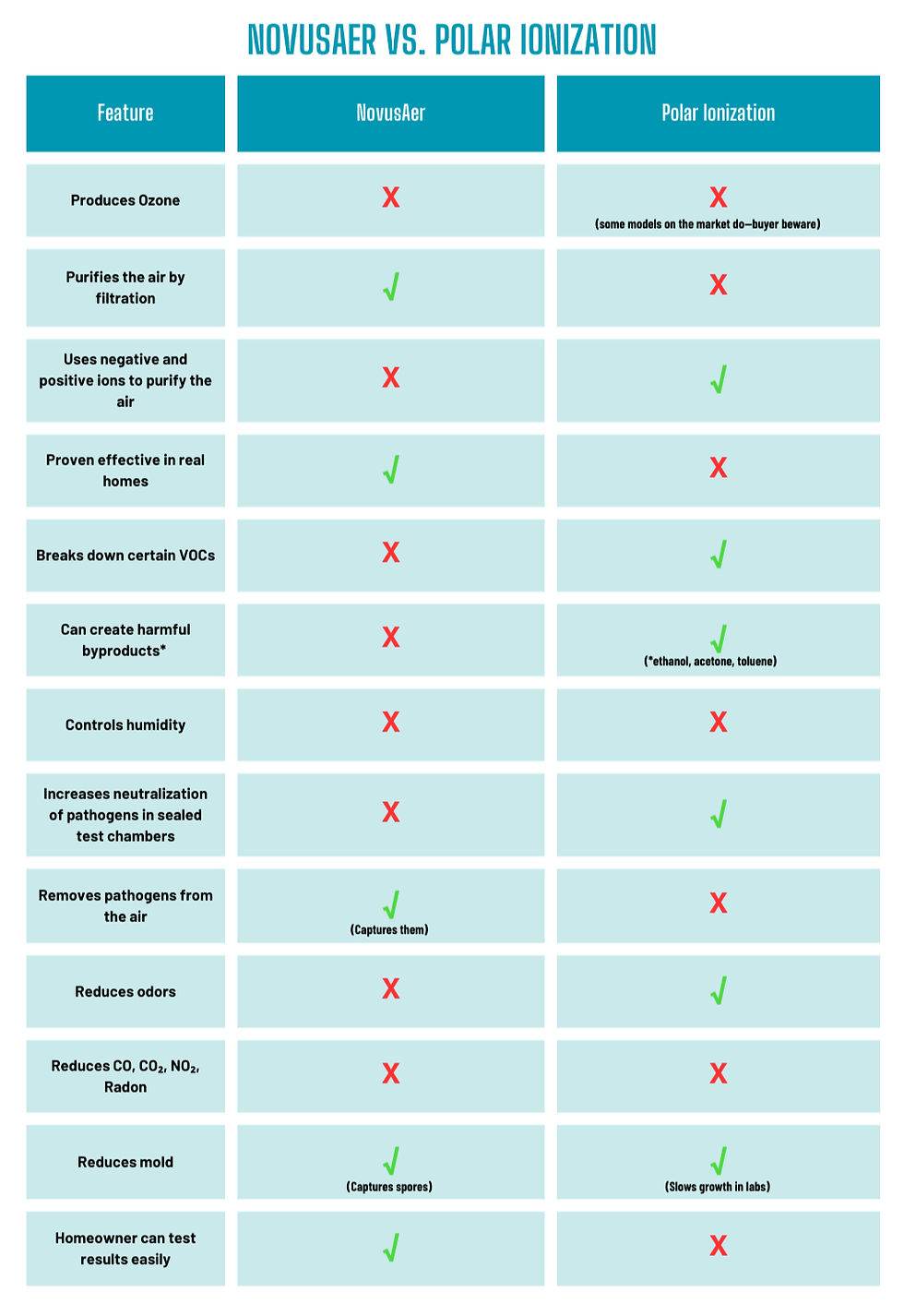
Digging Deeper: What These Differences Mean for Your Home
1. Ozone Production
Both technologies can be ozone-free—but some ionizers on the market do produce ozone. The NovusAer filter does not.
2. Real-World Testing
The NovusAer was tested with laser particle counters in homes for 5 years before being tested in an ASHRAE-certified testing laboratory.
No Bipolar Ionizers have ever been tested and proven to be effective in any homes. Just like testing products on mice is not the same as testing products on humans, testing products in test laboratories is not the same as testing products in real, not simulated, homes.
A sealed test chamber is not the same as a real house, which has:
Open spaces
Doors and windows
Sunlight
Air leaks
People going in and out
Ventilation air mixing
3. VOC Reduction
The NovusAer filtration system cannot remove gaseous chemicals. Ionizers can break down certain VOCs—but this has only been proven in laboratory test chambers.
4. Byproducts
NovusAer air filtration creates no harmful byproducts. Multiple studies show that ionizers can create ethanol, acetone, and toluene—VOC chemicals you do not want more of in your home.
5. Pathogens
The NovusAer filter captures bacteria at nearly 100% and viruses at 80–90%.
Bipolar Ionizers have been proven to increase the natural decay of bacteria, viruses, and other pathogens by about 10% to 20% more than their normal decay rate in laboratory test chambers. Bipolar Ionizers do not directly remove anything from the air.
6. Odors
Bipolar ionizers may reduce odors; results vary widely. The NovusAer does not target odors because it does not use activated carbon.
7. CO, CO2, NO2, and Radon
Neither the NovusAer or Bipolar Ionizers remove or reduce carbon monoxide, carbon dioxide, nitrogen dioxide or radon gas from the air.
8. Mold
Both technologies help—just in different ways:
NovusAer: captures mold spores from the air
Ionizers: reduce mold growth in sealed labs
8. Homeowner Testing
You can test the NovusAer’s, or any air filter's performance yourself with a $39 laser particle counter purchased on Amazon. There is no simple way for a homeowner to verify whether ions are reaching the living space or working as promised.
Final Thoughts
Both technologies have their place, but they behave very differently in real homes. Filtration is predictable, proven, and easily verifiable. Bipolar ionization is somewhat effective in controlled laboratory settings, but real-world performance in homes remains unproven.
If you have more questions about air quality technology, send them to info@essentialairproducts.com. We’ll respond individually—or, if your question may help others, we’ll feature it on our “You Ask, We Answer” page.
Breathe well, Dan


tỷ lệ kèo bóng đá hôm bữa mình lướt thấy nên bấm vào xem thử cho biết, kiểu tò mò thôi chứ mình không hay cá cược gì. Đọc vài đoạn đầu thấy họ giải thích khá dễ nuốt, nói thẳng tỷ lệ kèo là con số thể hiện khả năng xảy ra của một kết quả trong trận, nên người mới cũng hiểu được đại khái nó dùng để làm gì. Mình thích cái cách họ viết ngắn gọn, không nhồi chữ, mỗi ý tách ra rõ ràng nên đọc trên điện thoại cũng ổn. Giao diện nhìn đơn giản, kéo xuống không bị rối, các tiêu đề lớn chia mục rõ nên mình lướt phát là thấy ngay…
Tải Hitclub mình bấm vào xem thử vì thấy bạn bè nói hoài, tưởng đâu vào sẽ rối mà ai ngờ khá dễ chịu. Trang chia nội dung theo từng khối nhìn rõ ràng, kéo xuống là thấy phần nói về link app iOS APK với đoạn tổng quan tách bạch, không bị dồn chữ ngộp mắt. Mình hay dị ứng mấy web màu mè, mà ở đây tông nâu vàng nhìn ấm, không chói, đọc lâu cũng đỡ mỏi. Có chỗ nhắc giao diện 4K, mình không quan tâm thông số lắm nhưng cảm giác hình ảnh sắc nét thật, kiểu icon khung nội dung nhìn “gọn” và hiện đại. Nói chung lướt trên điện thoại thấy mượt, tiêu…