
Which is Better: Portable Room Air Purifiers or Whole Home Air Purifiers?

Updated: Sep 11, 2025
Response by Dan Dearden, CAFS – Certified Air Filtration Specialist, Essential Air Products Founder, NovusAer Inventor
Great question! The answer is: it depends.
Before we get into the differences, let’s talk about what Portable Room Air Purifiers (PRAPs) and Whole Home Air Purifiers (WHAPs) have in common:
How They’re Alike
Same basic job: Both use high-efficiency air filters to trap particles from the air passing through them.
Sized the same way: To keep air clean, experts recommend filtering all the air in a space about five times an hour. This is called Air Changes per Hour (ACH).
Optional extras: Both can be upgraded with add-ons like UV lights or ionizers for germ-killing power.
Odor reduction: Adding charcoal to the filter can help reduce smells in both systems.
Affected by home “leaks”: Both work less effectively if your home has a high air infiltration rate—dirty outside air sneaking in through cracks and gaps. Sealing and weatherizing your home boosts performance for either option.
Examples
PRAP Example: For a living room 14′ × 20′ × 9′ tall, you’d need a purifier with a Clean Air Delivery Rate (CADR) of 357 cubic meters per hour (m3/h) or about 210 Cubic Feet per Minute (CFM) to achieve the recommended 5 ACH. The IQAir Atem X ($1,399) is one example that meets this need.
WHAP Example:For a 1,400 sq. ft. home with 9′ ceilings, you’d need an HVAC system delivering about 1,050 CFM to hit 5 ACH (equivalent to a 2.5-ton AC system).

How They’re Different
Coverage:
A PRAP is designed to clean one room, and one room only.
A WHAP cleans every room connected to your central HVAC system.
Room sealing:
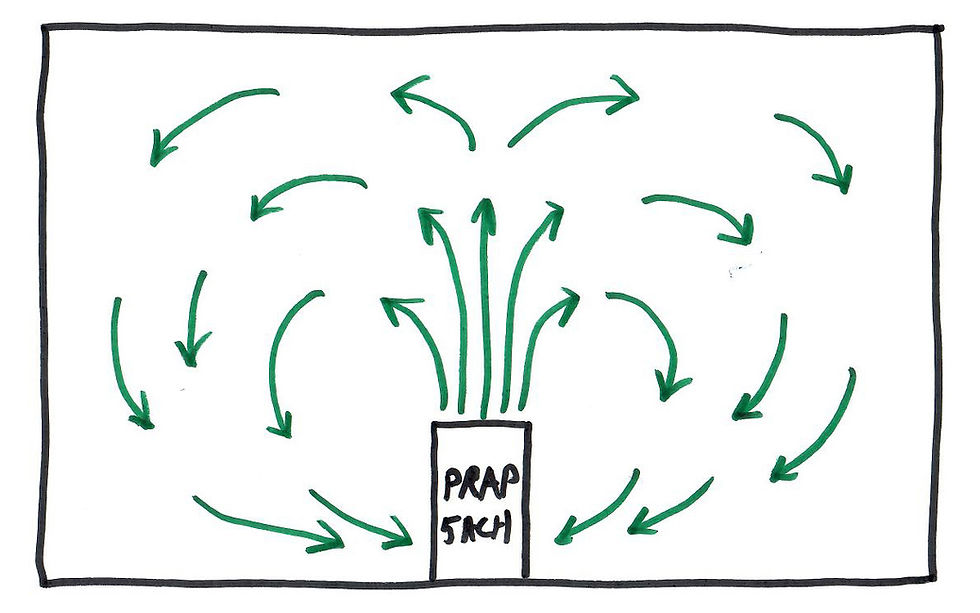
A PRAP works best in a room that’s sealed from other air sources (except for natural infiltration). If the room is connected to a forced-air system, unpurified air can constantly replace the cleaned air—canceling out the purifier’s work.

Improper application of a PRAP. A PRAP in an unsealed room, connected to a forced-air system.
A WHAP pushes clean, purified air through every room and replaces the dirty air throughout the house.
Number of units needed:
To clean an entire home with PRAPs, you’d need one in every room.
With a WHAP, you need just one unit for the whole home (as long as it’s all served by the same HVAC system).
Filter lifespan:
PRAP filters are small and often need replacing every 3 months.
WHAP filters can be much larger—some last up to 3 years.
Installation compatibility:
PRAPs work anywhere in any home.
WHAPs require a compatible HVAC system—some systems in confined spaces may not be able to accommodate one.
Best fit situations:
PRAP: Perfect for ductless or radiant heating/cooling systems.
WHAP: Great for homes with central forced-air HVAC.
When to Choose a PRAP
Your home or a specific room uses ductless or radiant heating/cooling.
Your HVAC system can’t accommodate a WHAP.
You rent and want to take the unit with you when you move.
You need to isolate a contagious person in a sealed room. To keep the room isolated, you will also need to provide independent heating and cooling services.
When to Choose a WHAP
You want HEPA-level pirified air in every room of your home.
You want low-maintenance filters that last up to three years.
You want to protect your HVAC equipment by keeping it clean inside.
You’d like to reduce dusting by adding an infiltration mitigation duct to your filtration system.
You want the lowest possible annual maintenance cost while maintaining HEPA level air purificaiton.
Bottom Line:
If you only need to clean the air in one room—or can’t install a WHAP—go with a PRAP.
If you want whole-home coverage and have a compatible HVAC system, a WHAP is the best long-term solution.
Don’t waste your money by putting a PRAP in a ventilated room. (Caution: If you close off the ventilation, you essentially close off the heating and cooling.)


rr88 com mình mới ghé thử vì thấy bạn bè nhắc hoài, tưởng đâu vào sẽ rối mà hóa ra nhìn khá dễ chịu. Trang chủ bố cục gọn, chữ to vừa phải nên lướt nhanh vẫn nắm được ý, không bị nhồi quá nhiều thứ một lúc. Mình chỉ đọc sơ phần giới thiệu thôi thì thấy họ có nhắc RR88 tham gia thị trường từ năm 2018, kiểu thông tin nền tảng cho người mới đỡ phải đoán mò. Kéo xuống dưới thì các đoạn nội dung được tách thành từng khối riêng, nhìn giống mấy box nên mắt bắt nhịp nhanh, không phải căng ra đọc một mạch dài. Menu đặt ngay chỗ dễ thấy, và phần…
cổng game bài hitclub mình cũng mới ghé thử vì thấy bạn bè nói nhiều, chủ yếu vào xem trang họ làm có dễ dùng không thôi. Vừa mở lên thấy giao diện khá sáng sủa, các khối nội dung chia tách rõ nên lướt xuống không bị rối. Mình để ý họ có phần giới thiệu kiểu “lịch sử” thông tin nền tảng từ năm 2015 nhìn cũng gọn, đọc lướt vài dòng là hiểu đại khái. Menu đặt ngay chỗ dễ thấy nên chuyển qua lại giữa mấy mục nhanh, không phải mò. Nói chung cảm giác site này sắp xếp theo dạng từng cụm thông tin, tiêu đề nổi bật nên nhìn phát biết mình đang ở…
Really helpful guide for understanding the best air purification option depending on your home and HVAC system. The long-term benefits of WHAPs were well explained. For even better indoor air quality, a uv air purification system can be a valuable addition to support cleaner, safer breathing spaces.
tỷ lệ kèo nhà cái mình thấy bạn bè nói suốt nên bữa rảnh mình ghé vào coi thử cho biết thôi. Mình không soi sâu nội dung, chủ yếu xem họ làm giao diện ra sao. Vừa vào là thấy trang nhìn sáng và dễ thở, chữ không bị dồn dập nên lướt khá thoải mái. Mình thích nhất là mấy khung dữ liệu họ trình bày theo cột, nhìn qua là biết đâu là con số chính, không phải đọc lan man. Với lại cái menu đặt khá rõ, chuyển qua lại giữa các phần không cần bấm nhiều bước nên đỡ mất thời gian. Nói chung cảm giác như họ ưu tiên cho người xem nhanh, kiểu…
789f đăng nhập hôm trước mình thấy bạn bè nhắc hoài nên cũng bấm vào xem thử cho biết, chủ yếu ngó giao diện chứ không ham hố gì. Cảm giác đầu tiên là trang trình bày khá thoáng, kiểu chia từng khối nội dung rõ ràng nên lướt xuống không bị rối mắt. Mình có thấy họ có nhắc vụ bảo mật SSL 256-bit, đọc qua là hiểu ý chứ không viết kiểu dài dòng khó nuốt. Cái mình thích là phần tiêu đề để to, nhìn phát biết đang ở bài “LINK ĐĂNG KÝ… 2026” ngay đầu trang, kéo xuống thì các đoạn vẫn tách gọn gàng theo block.